At Greenhouse Studios we often think about the importance of collaboration, and the need to have project teams made up of diverse talents. The Irish Paleography Primer and Quiz we launch this week, an output of the larger Léamh project, demonstrates the value of such collaboration. The project team included experts in the Irish language, Christina Cleary and Deirdre Nic Chárthaigh, historians Emmet de Barra and Brendan Kane, as well as web developers Mackenzie Fox and Tom Lee.
For scholars who work with Irish-language sources, the ability to read handwritten documents is of crucial importance, as many historical sources in Irish have yet to be transcribed. Because these documents are written using particular letter forms, as well as specialized contractions and abbreviations, reading and transcribing them requires training in paleography, the study of handwritten documents.
Though a number of resources in Irish paleography are available to specialists and advanced learners, including Tionscadal na Nod and Irish Script on Screen (ISOS), there has long been a need for a primer in Irish paleography geared toward beginning and advanced students alike. Our hope is that the paleography primer and quiz will be a welcome resource for scholars, teachers, and others who want to learn or teach people how to read Irish manuscripts.
The Primer is divided into five sections, beginning with simple letter forms in Part 1.
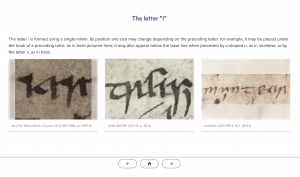
Parts 2 and 3 cover some of the more common superscripts, such as the m-stroke, the n-stroke, and superscript vowels.
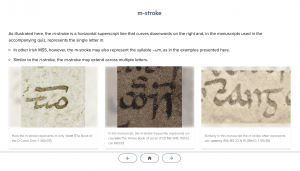
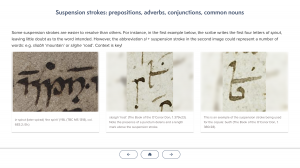
Part 4 introduces scribal abbreviations, including some of the more commonly used compendia, while Part 5 gives examples of scribal contractions and discusses the difference between contractions and suspension strokes.
The Paleography Quiz that accompanies the Primer allows users to apply and practice what they have learned. Users are presented with a manuscript image and prompted to transcribe the word or phrase shown in the excerpt. Users can choose to be tested on material from any one of the five sections of the Primer, or choose to be tested on material drawn from all five sections.
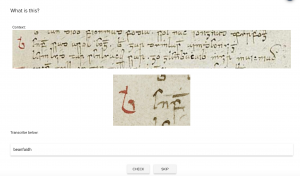
The Primer and Quiz can be accessed HERE.